Technology Platform
Technology Platform
The GWES technology platform brings intelligence to logistics facilities through 4 proprietary algorithms (mathematical optimization, LLMs, discriminative regression models, and time series analysis).
01OS Architecture
Comparing OS Architectures

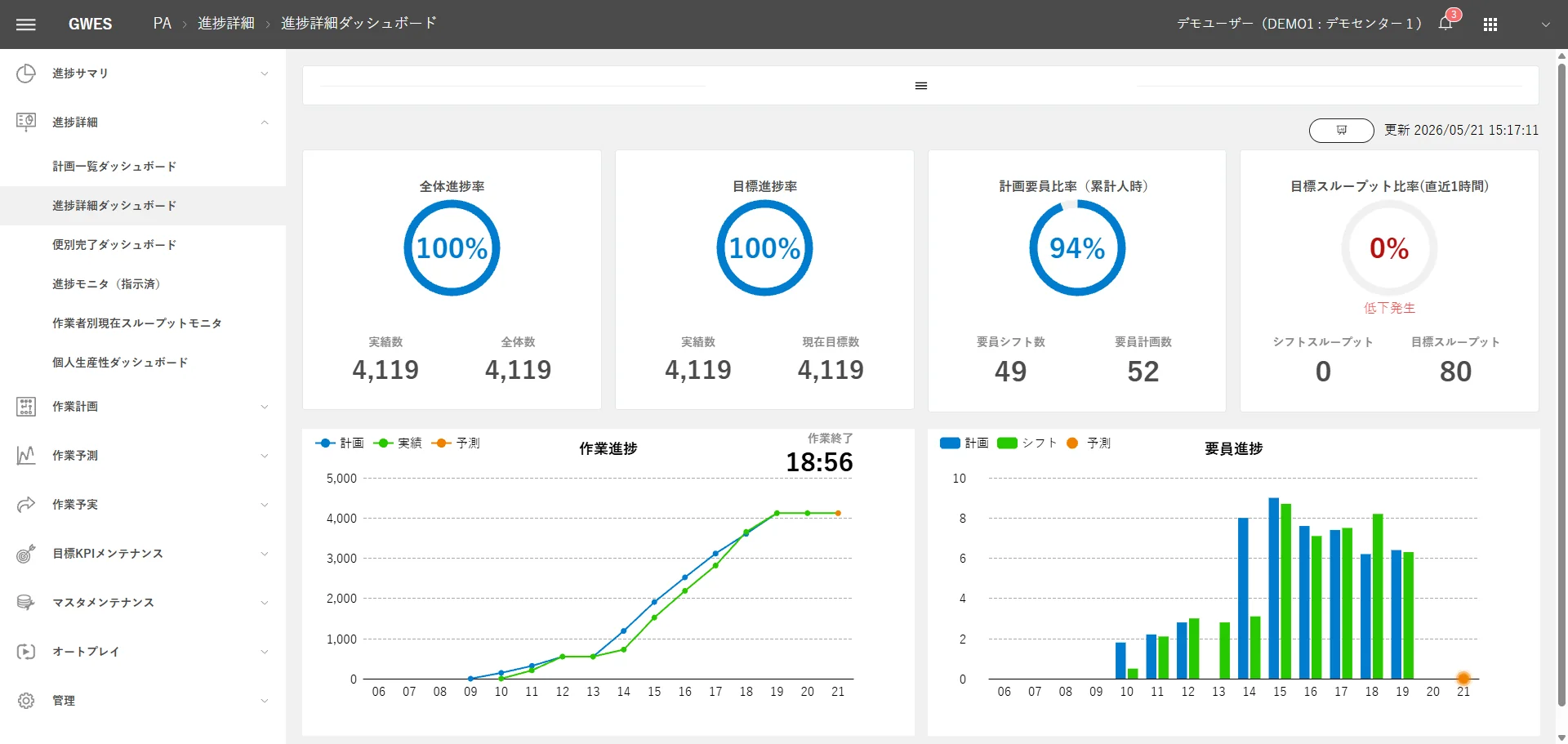
Actual screen from the GWES demo environmentEnlarge screen ↗
Conceptual OS architecture
Smartphone
- APPLICATION
- Camera · Maps · Payment
- DECISION LAYER
- iOS / Android
- FOUNDATION
- SoC · Sensors · Connectivity
Car
- APPLICATION
- Driving · Maintenance
- DECISION LAYER
- Vehicle OS
- FOUNDATION
- ECU · LiDAR · Cameras
Logistics facility
- APPLICATION
- Staffing · Forecasts · Quality
- DECISION LAYER
- GWES — Logistics OS
- FOUNDATION
- WMS · MHE · IoT
A smartphone OS such as iOS or Android sits above the SoC and sensor array and provides AI frameworks as an integrated whole. In-vehicle operating systems for connected cars (QNX / Automotive Grade Linux) likewise manage the sensor fusion of LiDAR, cameras, and other inputs together with autonomous-driving algorithms.
GWES follows the same design philosophy: as an OS that sits above a logistics facility's WMS, material handling equipment, and IoT sensors, it brings intelligence to facility operations through 4 algorithms.
Smartphone OS
Application
Social media, camera, maps, payments
AI / Framework
Core ML, Neural Engine, face recognition, speech recognition
OS Core
iOS / Android (Linux Kernel)
Hardware
SoC, sensors, communication modules
Connected Car OS
Application
Autonomous driving, predictive maintenance, digital cockpit
AI / Framework
Sensor fusion, route planning, object recognition
OS Core
QNX / Automotive Grade Linux
Hardware
ECU, LiDAR, cameras, V2X communication
GWES — Logistics OS
Application
Staffing optimization, shipment forecasting, quality control, autonomous facility operations
AI / Algorithm
Mathematical optimizationLLMs (generative AI)Discriminative regression modelsTime series analysis
OS Core
GWES
Infrastructure
WMS, material handling equipment, IoT sensors, ERP
02Algorithms
Four Algorithms Behind GWES
GWES develops and integrates the following 4 algorithms to automate the decision-making, forecasting, and optimization involved in running a logistics facility. Each algorithm works on its own, and the algorithms also work together to bring intelligence to facility operations as a whole.
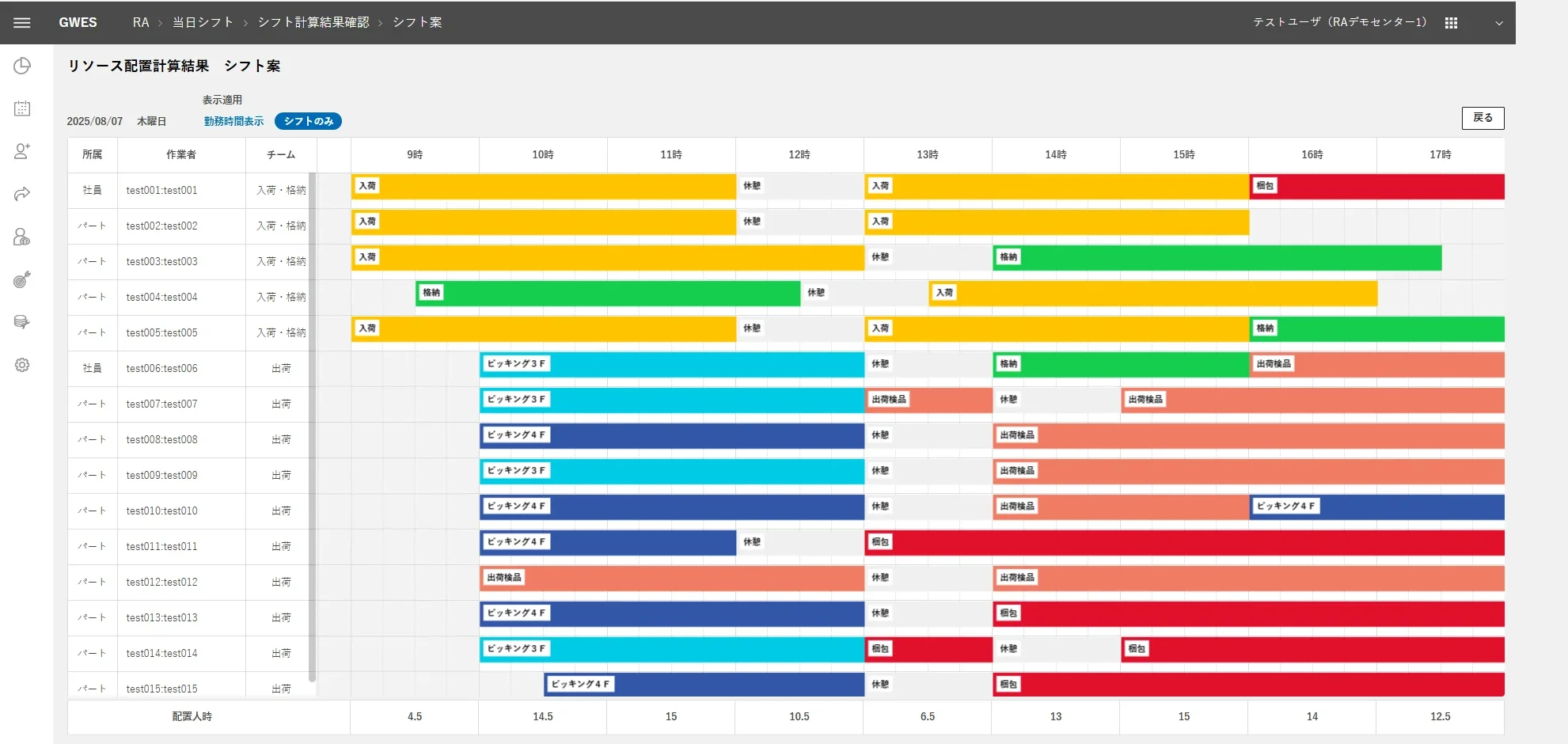
RAResource Allocation Optimization
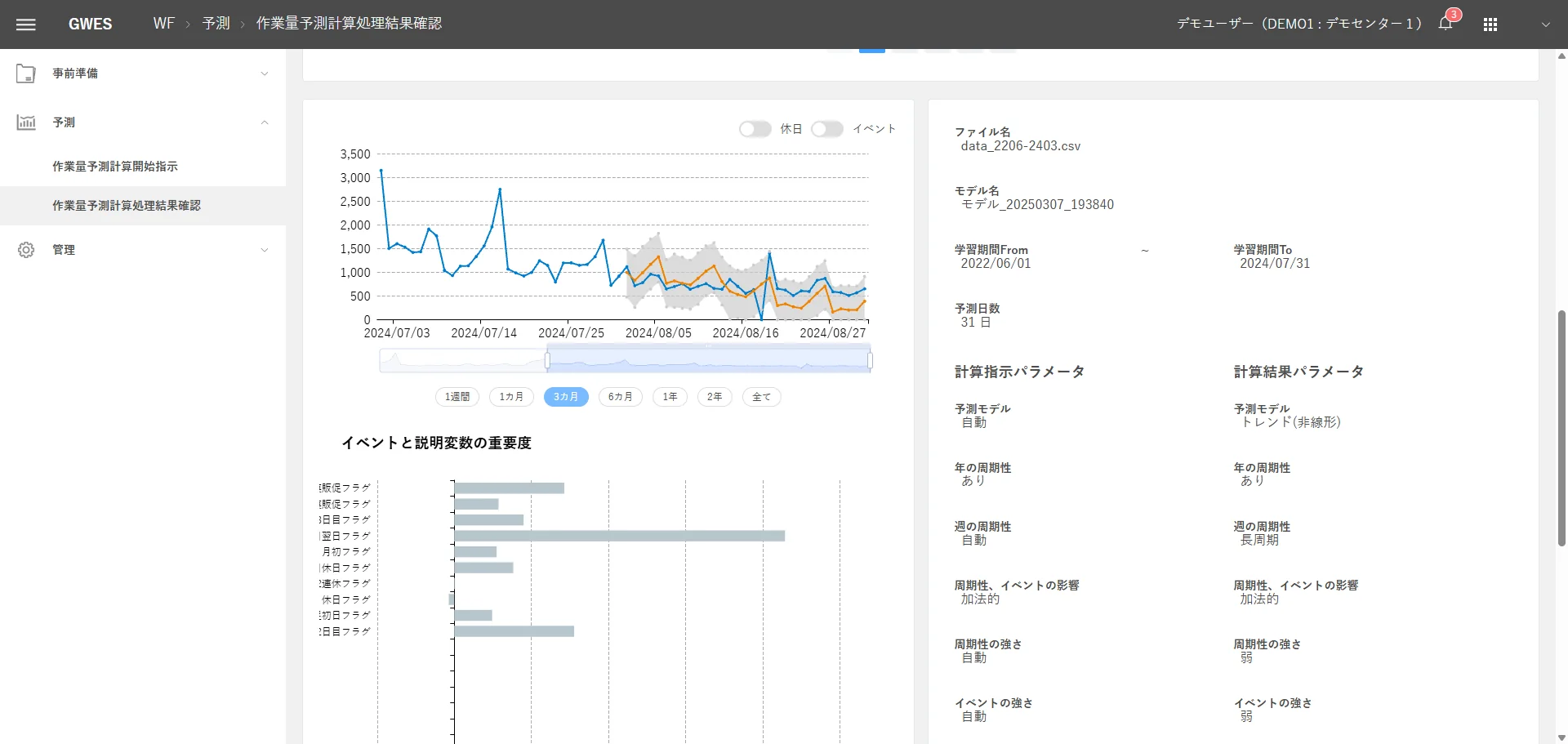
WFWorkload Forecasting
01
Mathematical Optimization
Mathematical Optimization
For combinatorial optimization problems such as staffing, task assignment, and travel-path design, GWES applies mixed-integer programming (MIP) and constraint programming. It quickly derives feasible solutions that maximize KPIs while satisfying many constraints at the same time.
02
LLMs (Generative AI)
Large Language Models
Using large language models, GWES automatically generates operational reports, estimates causes and proposes countermeasures when it detects anomalies, and extracts knowledge from the knowledge base. It turns unstructured data into practical insights.
03
Discriminative Regression Models
Discriminative Regression Models
Supervised learning with gradient boosting (XGBoost / LightGBM) and neural networks delivers high-accuracy task time prediction, quality assessment, and early detection of equipment degradation.
04
Time Series Analysis
Time Series Analysis
GWES applies seasonal decomposition (STL) and state-space models to time series data such as outbound volume, inbound volume, and workload. Short- to medium-term demand forecasting and anomaly detection make forward-looking resource allocation possible.
FIRST STEP
See where you stand with a free GPIM assessment
We clarify which level your logistics facility is at now and what to do next.
Explore other options